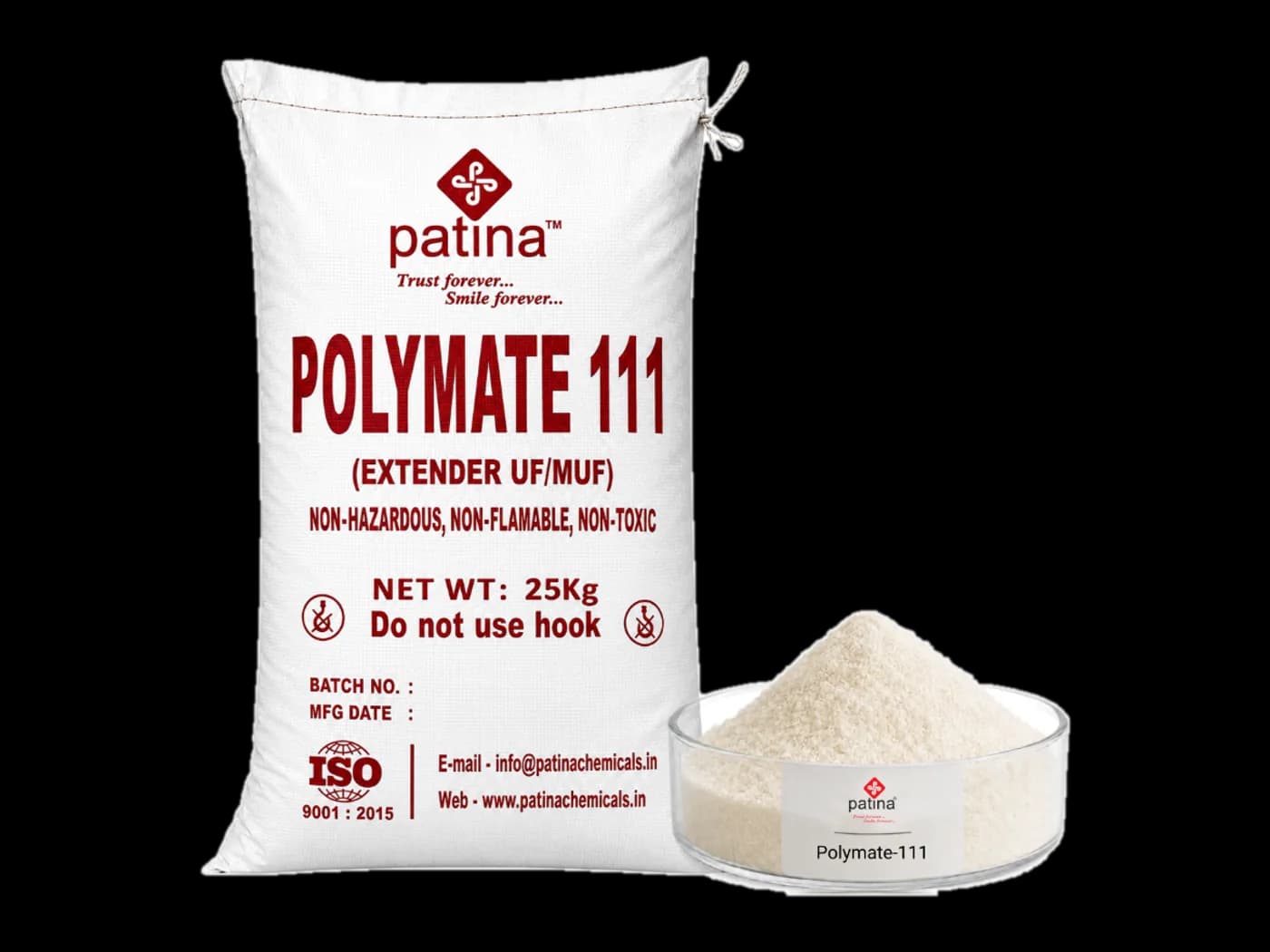
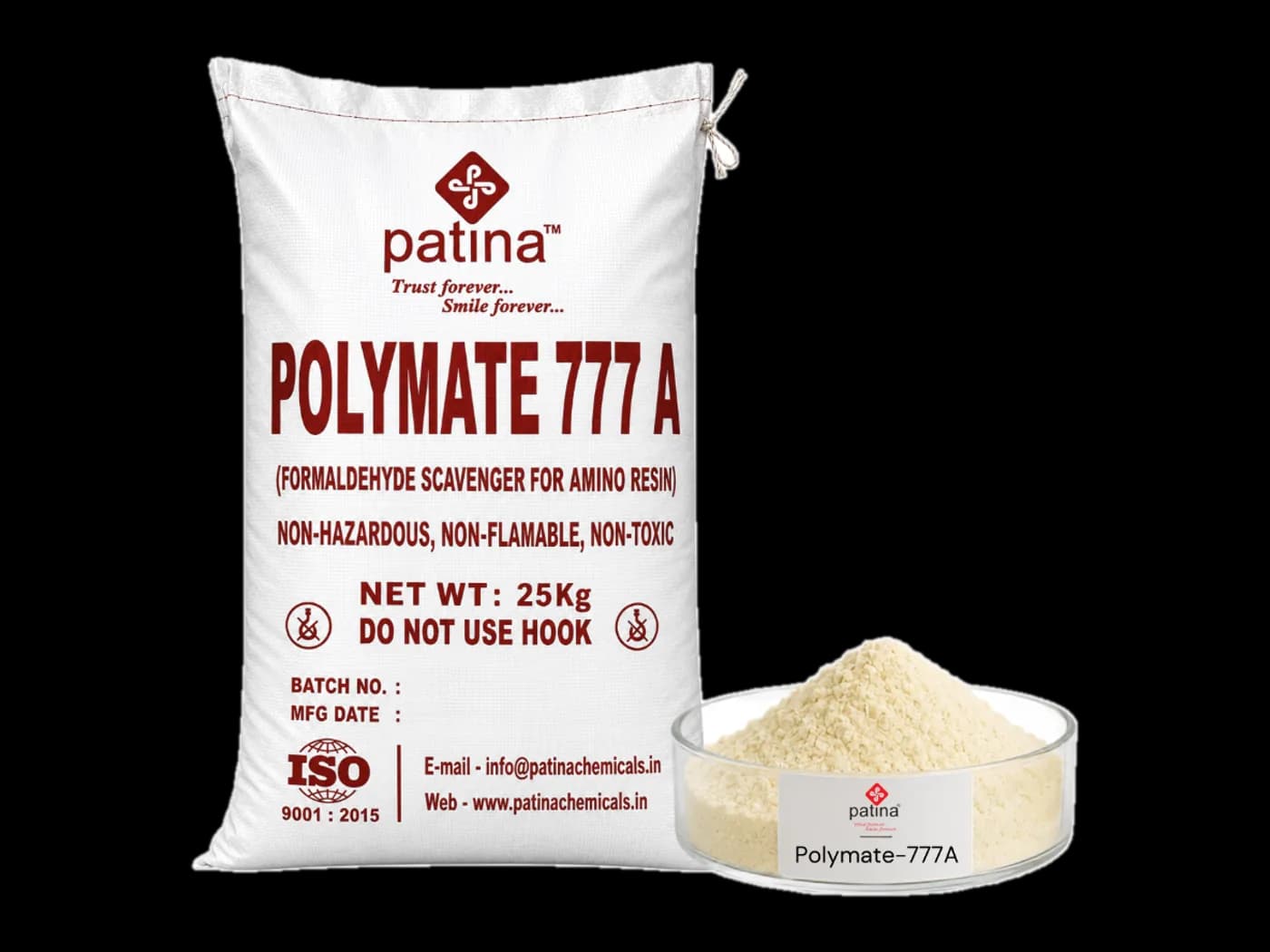
Emission limits are the one specification that has moved consistently in one direction for the last decade. E2 became the floor, E1 became the expectation, and E0 is increasingly what a buyer means when they say “low emission”. For a panel maker the awkward part is that free formaldehyde is not a defect you can inspect your way out of — it is a property of the resin chemistry you are already committed to.
This is a working note on where scavengers fit, what they change on the line, and how to run a trial that actually settles the question.
Why the resin alone rarely gets you there
Urea-formaldehyde and its melamine-modified relatives cure by condensation, and that reaction is never complete. Some fraction of formaldehyde stays unbound in the panel and keeps migrating out long after the press opens. You can push the numbers down by lowering the formaldehyde-to-urea molar ratio, but you pay for it twice: slower cure and weaker bonds.
That trade is why most mills stall somewhere above target. The resin is doing what it can. What is left is the free formaldehyde already in the system, and that is a scavenging problem rather than a formulation problem.
What a scavenger actually does
A scavenger carries reactive sites that bind free formaldehyde into a stable, non-volatile compound. It is not a masking agent and not a surface treatment — it works inside the glue line, through the panel, and what it captures does not come back.
The practical consequence is that a scavenger is additive to whatever you have already done to the resin. A mill that has taken its molar ratio as low as bond strength allows can still take another step down without touching the resin again.
Matching the grade to the resin
Scavenger chemistry has to suit the resin it lives in. Amino and phenolic systems cure differently and tolerate different additives, which is why the range splits in two.
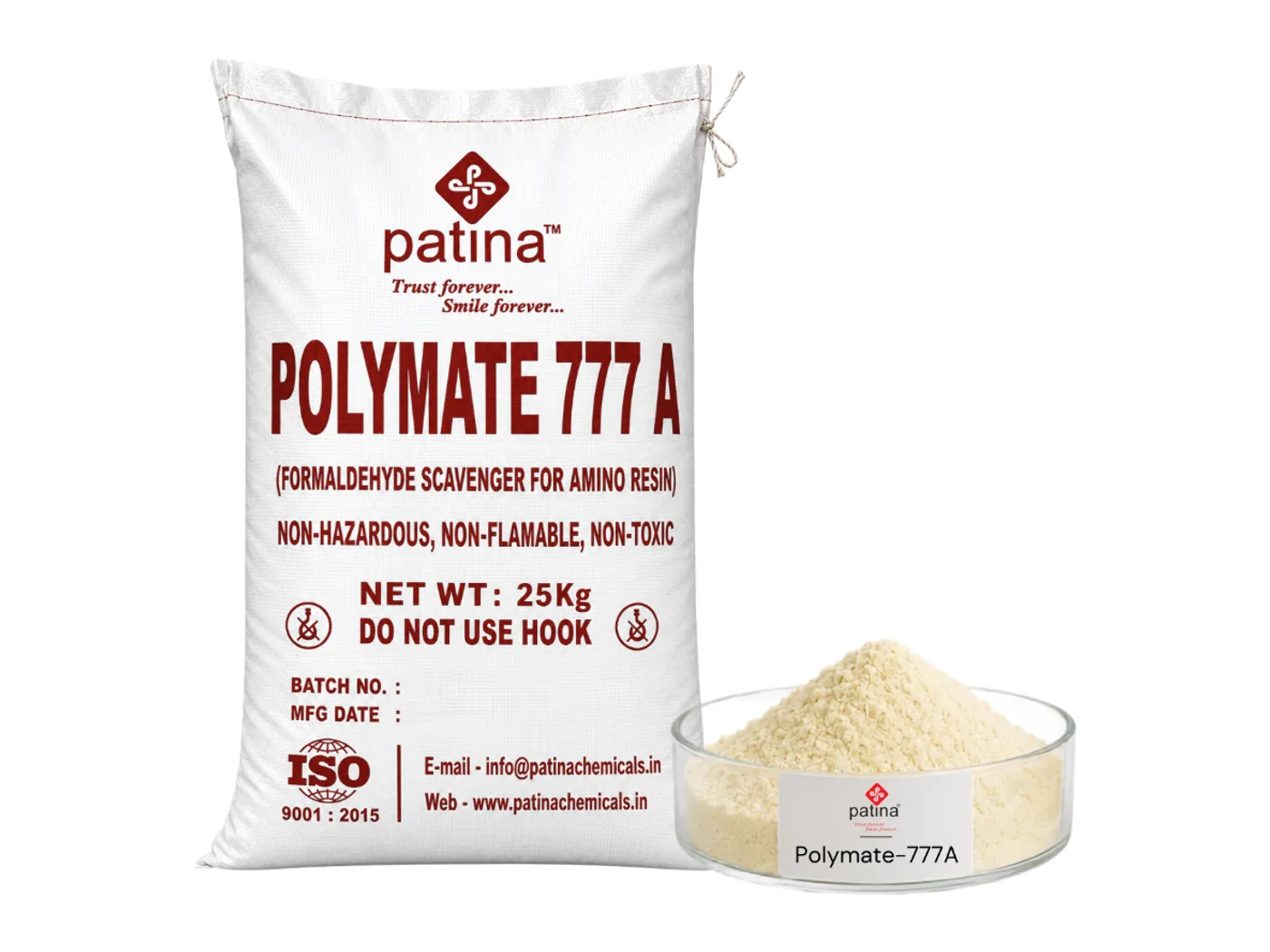
- Amino resins (UF, MUF). Polymate-777A, a light-yellow fine powder, is optimised for these systems. It is the grade behind most interior-grade plywood, particle board and MDF work.
- Phenolic resins (PF). Polymate-777P, a reddish-brown powder, is engineered for high-durability phenolic systems — exterior-grade plywood, heavy-duty MDF and board that has to survive weather.
Using the amino grade in a phenolic system is the most common avoidable mistake. The cure environment differs enough that performance falls away, and the usual conclusion — “scavengers don’t work on our line” — gets drawn from the wrong experiment.
What it costs
This is the number that decides most conversations, and it is smaller than people expect. For Polymate-777A the addition works out at roughly Rs. 0.05 to Rs. 0.06 per glue line.
Set against that: a compliant panel commands a better price, opens export routes that are otherwise closed, and removes the risk of a batch being rejected on test after it has shipped. The cost of compliance is a rounding error next to the cost of non-compliance discovered late.
Running the trial
A scavenger trial is cheap to run and easy to run badly. The failure mode is almost always that too many things changed at once, so the result cannot be attributed to any of them.
- Fix your baseline. Measure free formaldehyde on current production, using the method your customer or certifier will use. A number you cannot reproduce is not a baseline.
- Change one thing. Add the scavenger at the recommended starting dose. Do not simultaneously adjust molar ratio, press cycle or moisture content.
- Hold the press cycle. The point is to prove the additive works inside your existing process. If the cycle changes, you have proven something else.
- Read strength as well as emissions. Bond strength and shear should be unchanged. If they moved, the dose or the grade is wrong.
- Let the panels sit. Readings taken straight off the press flatter everyone. Condition the panels, then re-test.
Two or three runs is usually enough to see the shape of the curve and settle on a dose.
Where it tends to go wrong
A few patterns come up repeatedly on plant visits:
- Under-dosing to save money. The saving is a fraction of a paisa per glue line and the result is a panel that misses target — the worst of both outcomes.
- Poor dispersion. A scavenger that is unevenly distributed protects unevenly. Mixing discipline matters as much as dose.
- Testing too early. Panels straight off the press have not equilibrated.
- Expecting it to fix a wet-veneer problem. High moisture content is its own issue with its own chemistry. Scavengers address emissions, not moisture.
The short version
If your resin is already as lean as bond strength allows and you are still above target, you will not formulate your way to E1 or E0 — you need to bind the free formaldehyde that is left. That is a well-understood problem with a well-understood answer, it costs a few paise per glue line, and a properly run trial will tell you inside a fortnight whether it works on your line.
Patina was the first Indian company to bring research-built scavenger technology to this industry, and our applications team supports trials on site. If you want to run one, tell us your resin system and your current numbers and we will suggest a starting dose.